Tuesday, October 15, 2019

Gender Roles, Women, and Power


In the Middle Ages, women were expected to respect the role and place given to them by their society and then their husband when they would eventually marry off to. Women were to be submissive and docile while shadowing their husbands and taking care or the children as well as household duties. There were no other tasks for a woman and lady at this point in time. As a little girl, she would be trained all her upbringing to serve those around her. Women during the Middle Ages were to be educated to some degree in addition to upholding her female responsibilities; however, using her knowledge in competition with any male counterpart was forbidden. This was set in place because no matter what, males were to always hold the dominant position and their opinions were the only ones that mattered. As the Guerilla Girls said it best, “Let the woman learn in silence with all subjection. But suffer not women to teach, nor to usurp authority of the man, but to be in silence” (G.G., 19). This proves what was already stated. Women had specific roles that cloaked their individuality and identity. Although women were extremely oppressed, the era of the time very slowly began to give way to the women who could make their mark as paint artists, sculptors, and workers of crafts overall.


Religion in the Middle Ages seemed to underscore the order of life. Religion; in addition to men, was responsible for the persecution of women. Set by the Holy Church itself, women were to be modest and obedient beings. Opposition to this image represented in physical and emotional repercussions. Remember, women had few choices throughout their childhood and then subsequent adulthood. The Guerilla Girls explained, If one chose not to fulfill her purpose and role of becoming a wife and mother, she often went to join a convent; this had the effect of freeing herself from these oppressive duties in that role (G.G., 21). Most unfortunately, in families with many daughters, if there was no money left due to fortunes spent on dowries on the other sisters: this also resulted in a new addition to the convent. For the lovely women that made it to be wed, “they were required to be faithful to their husbands” or subjected to punishment,”by flogging or being buried alive” (G.G., 22). Men, however, could commit adultery without any repercussions as long as it wasn’t with another man’s wife.


Religion, moreover, was the subject matter of any and all works of art to be created and as one could imagine, this too was dominated by men. This meant women were inferior in this world of art too, they weren’t even included or represented in these works of art either like seen in the Bayeux Tapestry in 1066. However, this was only the start of women's creeping and eventually success in this male dominated field of work. The tapestry, although excluding women, was made by an anonymous woman and it was one of the “hits” of the time. This action and success started to pave the way for those in the Renaissance.
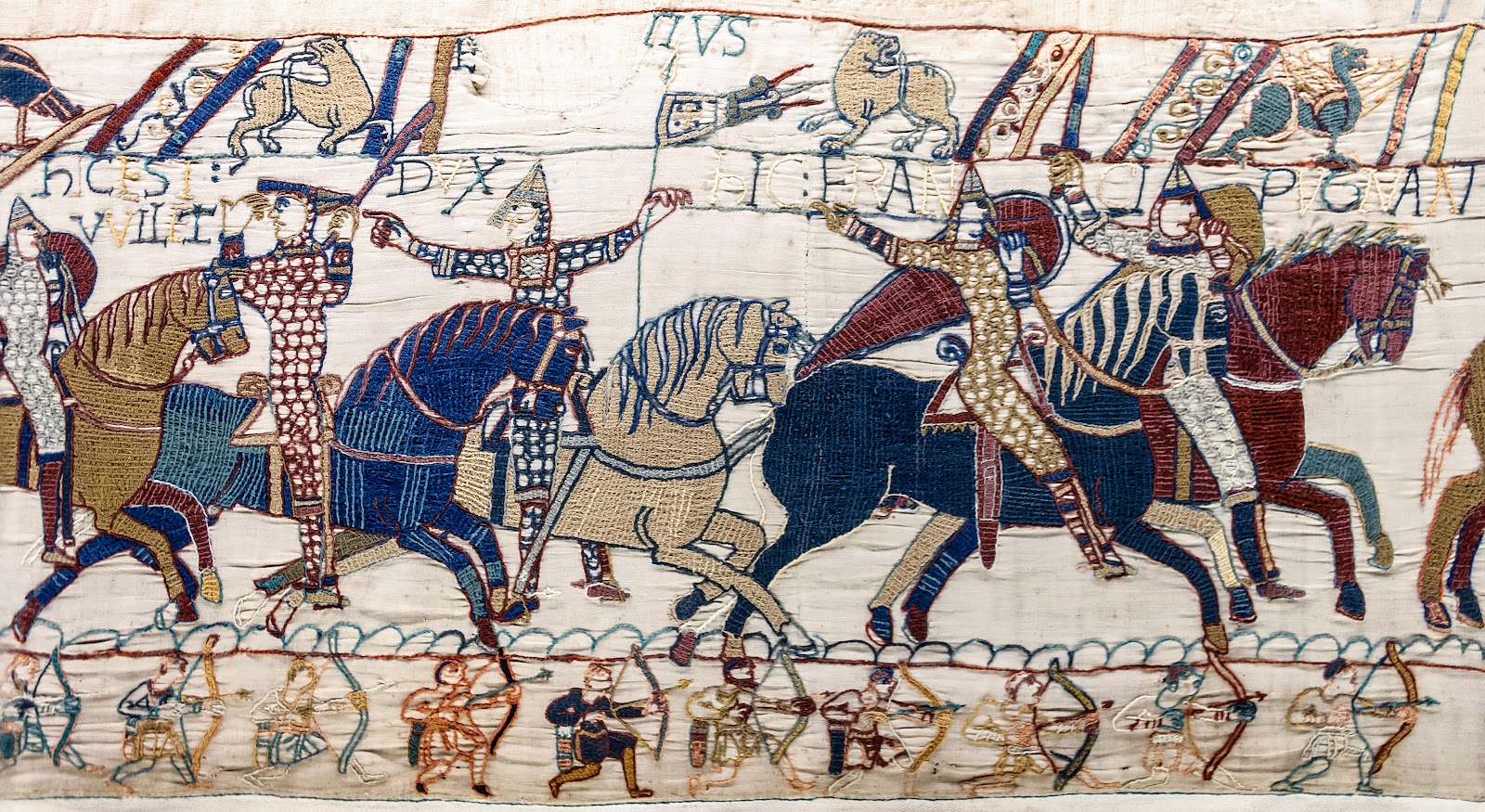


The Bayeux Tapestry is an embroidered cloth nearly 70 metres long and 50 centimetres tall, which depicts the events leading up to the Norman conquest of England concerning William, Duke of Normandy, and Harold, Earl of Wessex, later King of England, and culminating in the Battle of Hastings.


As the Middle Ages came to an end, women entered into a slightly more hopeful Renaissance Era were female artists shined alongside their male contemporaries, of course at unpopular opinion. Women very much had impressions in the art world but only if they had strong family ties with nobility. This era was a little funky when it took place because there seemed to be a step into distancing art from it once strong religious inspirations. This was because the society began to question the teachings and validity of the church and its position in people’s lives. This allowed for artists, men and women, to be more expressive with their creativity and subject matter. The art work in some ways began to critique society. It was already hard enough for women to get to the position where they could make artwork let alone getting to the impossible position of being able to sell their artwork. Artists usually had to apprentices with already established artists and join a union in order to eventually open shop, a very long process. The system was of course closed to women because they were basically barred from being guided and attending academies. The Guerilla Girls informs that, “one of the few ways women could work as an artist was to be born into a family of artists that needed assistance in the family workshop” (G.G., 29). A known exception to this rule was Sofonisba Anguissola, a noble whose father believed that women should be educated. As it can be understood, if a woman did not have such exceptions or criteria, her dream of performing alongside her male counterparts was as good as futile. Women like Anguissola were needed to penetrate some type of standing for further women to uphold.


"Her expression is calm and reserved. A maulstick (a common device used to support the artist's hand) held in her left hand supports her right hand as she touches the brush to the canvas. Sofonisba Anguissola, Self-Portrait, 1554, oil on poplar wood, 19.5 x 12.5 cm (Kunsthistorisches Museum, Vienna)"


Sofonisba Anguissola was born into a noble family or wealthy aristocrats. She was the oldest daughter of six children who all showed talent in some way. Her father supported the notion that women too should be educated and he fostered her learning in this way. Through her father, she studied literature and art and even created some pieces of art. Her father in fact sent one of her drawings to Michelangelo. Unlike her male contemporaries, Anguissola presented women with a powerful and meaningful depiction. She was a portraitist who painted her subjects with dignity, including herself. She painted a famous portrait of herself painting another portrait. And in the portrait, she is staring into the eyes of her on looker with seriousness and morality. The point in painting such actions was to prove to the male dominated world that women could in fact be subjects; however, they were capable of much more than just being nude and on display to be gawked at. Women, like men had just as similar capabilities as human beings and of course as artists. Because she painted with such dignity, her craft led her to paint other larger nobles like the Queen of Austria. Chadwick acknowledges that Anguissola, “opened up the possibility of painting as a socially acceptable profession” (77). This is something that was unheard of before. Now of course her work was criticized but she showed the expertise of someone who had gone through the professional route of learning in an actual school. Expertise of both women and men caramelized with new opportunity granted from the Industrial Revolution.


Queen of Austria painted by Anguissola


The 19th Century was the bearer of a new founding culture brought on by the Industrial Revolution. The Industrial Revolution was a period of transition into manufacturing processes. The revolution brought new technologies into fruition and that allowed for easier access to supplies, especially for women. One of the new technologies was the invention of the camera, which threatened realist portraitists because the camera captured an actual still image of the subject. Even though photography jeopardized the world of paint, it also offered the option of new field work in which women could get into. Familiarly, there was still a fight for women to become established and for their work to be properly credited. This soon enough became an underlying theme for women; they had to prove more than ever that they had rightfully earned several seats at the competitors table.


The 19th Century paved the way for strong and bold women artists to make a purposeful stain in history. Women like Rosa Bonheur for example created works of artistic realism of spaces that were predominantly occupied by men. She loved painting horses, cows, and bulls; she also cross dressed in men’s clothing. She did this to receive a permit to facilitate her work, something only men could obtain at the time. Edmonia Lewis was another important figure who sculpted, she was African American and Native American. She created marble sculptures to prove women could also prevail in that field. She fearlessly sent her sculptors to people she knew that wouldn’t buy her work, with invoices and ultimately profited from that process for a little while. These were just a couple of examples of strong and determined woman that took charge of their dreams when adversity was against them. Ultimately women were able to break the mold casted upon them century after century and that shows that women have always and still continue to embody what true power is.

Gender Roles, Subject and Power


Aelfgyva and the Cleric, The Bayeux Tapestry, 1086
     "A woman must be a learner, listening quietly and with submission. I do not permit a woman to be a teacher, nor must a woman domineer over a man; she should be quit." (Chadwick, 45). The comprehensive phrase describes women's roles in a nutshell in the Middle Ages. Women's social roles then were framed by Christian ethics that highly stressed obedience and chastity. Their responsibilities were strictly maternal and domestic. Despite church ruling, every aspect of lives, AElfgyva and the Cleric from The Bayeux Tapestry, emphasizes the focus on military heroes and its subtexts concern loyalty, bravery, treachery. For many women, the only way for them to work as if it was for a business that was owned by a male family member (Guerrilla Girls, 19). Education wasn't on the horizon for females nor the independence of the mind and body.


’Woman’s Rights’ ephemeral card depicted the traditional roles and expectations of women

Moving towards the Renaissance time, some women, artists, in particular, began to push back against this notion that women should not be taken seriously. However, even then, it would make a great deal of effort for them to create their original pieces. On multiple occasions, a male would steal a female's artwork or the least dictate how it should be expressed.  For the most part, women were supposed to create only pieces that conformed to an acceptable structure of beauty and modesty; this was expected of her own appearance as well (Chadwick, 139). "As long as the women artist presented a self-image emphasizing beauty, gracefulness, and modesty, and as long as her paint appeared to conform this construction, she could, albeit with difficulty, negotiate a role for herself in the world of public art. (Chadwick, 139). The rules once again put the women in "their place." The art that is supposed to express the artist's own, vision, thoughts, and emotions had to instead confirm the audience's desires, needs, and demands. Needless to say, that the only audience back then were males. Although Renaissance is also known as a blooming period for the many aspects of life, especially art, women were forbidden apprenticeships, and they were barred from painters' guilds and academies. "One of the few ways a woman could work as an artist was to be born into a family of artists that needed assistance in the family workshop." (The Guerrilla Girls, 29). On the bright side, some humanist thinkers advocated individual equality of education for their daughters. A rare example of that is Sofonisba Anguissola, whose father beloved women should be educated. 


 Artemisia Gentileschi, Suzanne and The Elders, 1610
 The expected roles of women during the 19th century were overall to be seen but not heard and perform the necessary duties to help aid the men with their endeavors. The reform movements in the nineteenth century were influential and played a significant role in changing the economic and social changes these women faced (Chadwick, 175). These movements helped aid in women’s endeavors to establish themselves in a ’man’s world.’ However, even with these shifts in society, women’s location and class still played a significant role in how much freedom they experienced. Later, however, some of these roles began slowly switching over to more servants, and women were expected to have an education. Their education primarily consisted of attaining knowledge in the areas of drawing, music, modern language, and dance. They were shifting away from the domestic duties, and women were now expected to be considered ‘accomplished’ by being well educated in the above areas. However, there was a limit to how dedicated a woman should be to her studies. A woman who was overambitious in her pursuits was considered unfeminine. It was even stated by some doctors that too much studying could be physically damaging to a woman’s ability to reproduce. As far as virtues are concerned, chastity and motherhood were highly expected of women, and anything further was secondary. Some female artists began making bold moves with their work, painting influential female figures, or depicting their male mentor painting the artist’s portrait. 
Sofonisba Anguissola, Self-Portrait, 1556
This notion was previously unheard of, as it was the typical job of an apprentice to paint the embellishing details – so for a female artist to depict their mentor painting such petty details of a female portrait was a bold statement. It was no easy feat for these women to have their artwork taken seriously. A great example of a female artist famous for breaking the boundaries of the male-dominated world of art is Gentileschi. She was known for her bold, if not violent, paintings often depicting an act of strong female enacting revenge on a male. It is thought that some of the influence in Gentileschi’s works was attributed to her being sexually assaulted as a young adult. This is perhaps why her work so often portrays a level of violence and justice against men. It was sometimes questioned if a woman was capable of such paintings, but then decidedly so that no man would create paintings with such a strong female lead. 
Looking back, women have always been fighting for their ground and their place in society. They came a long way, and the battle is still not over. The issues women face these days are somewhat similar to what they were going through five hundred years ago, and the only difference is that we package them differently today.

Works Cited
Chadwick, Whitney. Women, Art, and Society. Thames & Hudson, 2012. 
Guerrilla Girls. The Guerrilla Girls’ Bedside Companion to the History of Western Art. Penguin 
Books, 1998. 
Hughes, Kathryn. Gender roles in the 19th century. British Library, 15 May, 2014, 


The Expectations of Women

Joan of Arc Enters Orleans, Jean-Jacques Scherrer, 1887

It has never been easy to be a woman. But now with the pressure society is feeling from the thousands of years of women's oppression, women are finally making small cracks in the glass ceiling. But it certainly wasn't easy for women during the Middle Ages, Renaissance, and going into the 19C. "In classical civilizations, women were the virtual prisoners of the men in their lives, but medieval women took part in almost every aspect of public life", (Guerrilla Girls, 19). Since this was the time of war and an enormous amount of poverty, women had to learn how to do men's roles while they were away at war. Women during the Middle Ages were not supported by the church to pursue anything that deemed "unwoman like to do", but they did it anyway which is pretty badass. They became writers, artists, merchants, nuns, and ran the kingdom when their husbands were away at war.  This is the same era that a young French girl named Joan of Arc led her country's army into battle and won while dressed as a man. The painting to the left made by artist Jean-Jacques Scherrer is culturally important because it is a man painting a woman at the forefront of her army. Something that would have never been able to be seen possible by a man.


Many artists in the Middle Ages were women. They either worked in businesses owned by male family members or living as nuns in convents. The most important medieval art that survived is considered to be the Bayeux Tapestry, a banner that is over 200 ft long. Scholars believe that women from the Kentish area of England embroidered the banner. "One scholarly book on the tapestry goes on and on about its historical and formal sources, but completely ignores the women who executed it. Instead, the author assumes the tapestry to be the design of a single male genius who hired it out to insignificant sewers", (Guerrilla Girls, 21).

Women who weren't nuns in the Middle Ages were usually engaged to be married at age 12 and were married by age 15. If she dared to marry another man she would be killed. If women committed adultery, they would be buried alive unlike their husbands who could do whatever they wanted. A woman could only dream of divorce if her husband forced her to have sex with another man. Almost no woman was taught how to read or write because it was seen as an interference with motherhood and being a "good wife". Women could work, but all their money would either go to their fathers, husbands, or brothers. A good beating was apart of the norm of a woman's life if she would disobey her husband.

Women in the Renaissance had more advantages than women in the Middle Ages, but still struggled to attain the same opportunities that were given to men. A woman could divorce her husband is she could prove he was impotent. Her reputation could be saved if she married the man that raped her. The only way a woman was allowed to receive education or teach was if she moved to Bologna, Italy. If she had an unwanted pregnancy, she could receive a legal abortion sanctioned by the Catholic Church, but there is a high chance that she would die. Underwear were only permitted if she was a prostitute, aristocrat, actress, or window washer. How they came up with that conclusion still boggles me.

Bologna was the city that offered so many opportunities to female artists that was unheard of before. Women were admitted to its university as early as the 13th century and were even permitted to lecture at the university. The city allowed so many women to learn philosophy and law which are even still to this day male dominated fields. A school was founded by the painter Elisabetta Sirani that took in female artists. During this time, Bologna was home to the most amount of female artists in Italy. Even with the improvement that the city had with its attitude towards women, a woman named Novello D'Andrea had to speak behind a screen to not distract the students with her "personal charm".

"I consider women writers, lawyers, and politicians as monsters and nothing but five-legged calves. The woman artist is merely ridiculous, but I am in favor of the female singer and dancer" the wise words said by Auguste Renoir (Guerrilla Girls, 47).

Rhode Island Female Artists learning how to paint, photographer unknown, 19th Cenutry
The 19th C was the beginning of the struggle to achieve women's equality. And at the same time, which is a coincidence, men brought back the objectification of painting the naked female body more than ever. With the many innovations of that time, came photography which was a great artistic path for women to take. Since it was a new invention, it was hard to be excluded from it. Because of this, women played a major role in how we use photography today. During the 19th C, a woman could finally become a practicing lawyer or doctor but to undergo the struggles they had to face to finish law/medical school made it nearly impossible.

One of the most famous female photographers of her time was Julia Margaret Cameron. She took her free time and used it to make a career that she would have never seen coming. Her daughter gave her a camera to fill up her free time to take pictures and from then on Cameron was addicted to photography. She used her maids as darkroom assistants and took portraits of anyone that would be happy to pose for her. Cameron took portraits mostly of young women and renowned old men. She sadly gave up her art to follow her husband Charles Cameron who was made governor of Ceylon. If she was a modern day woman, she would have never had to given up her artistic life for a man.


The Guerrilla Girls' Bedside Companion to the History of Western Art. New York: Penguin Books, 1998. Print.


Big Mouth

          Nothing is more threatening to our society than a powerful woman. The nature of a powerful woman is threatening enough to make society go to the greatest of lengths to try and strip her of her influence. Michelle Obama for example is one of the most influential woman of this era; however, the media has tried to strip her power away by simplifying her to her looks. "Monkey", "not classy", "disgraceful" were all adjectives that media outlets used— and continue to use— to describe Mrs. Obama. Society turned a blind eye to her countless charity events, philanthropic actions, and attempts to better the health of the country starting with our youth and made her physical appearance the focal point of their essays. Meghan Markle is unfortunately the star of media reduction as the media has never written a good article about her to date. The Duchess of Sussex has never done anything right according to the media and despite her efforts he has always been criticized. As a black women entering the life of nobility, her criticisms include but are not limited to her parenting, her facial structure, and even a wisp of hair out of place. So why is it that whenever a woman displays an ounce of power, society's primary instinct is to rip it from her? Whitney Chadwick's Women, Art, and Society and The Guerrilla Girls' Beside Companion to the History of Western Art both explore women artists and the effects that society has had on their influence and power over their civilizations.
          Beginning with the Middle Ages, women were considered to be theoretically inferior to men and were to be kept restricted in their male-run households. Chadwicks says, "The confusion of sovereignty with personal property contributed to the emergence of a number of powerful upper-class women at a time when most other women were restricted to the home and economically dependent on fathers, husbands, brothers, or sovereigns" (44). This indicates that sovereignty was considered a male role so with the wave of women coming into powerful and influential positions, society did not know how to handle it properly. Using artist Hildegard of Bingen as an example, she was an influential nun who was able to channel the word of God and transcribe it.  
Hildegard of Bingen, Scivais, 1152
The description of Hildegard receiving the word of God
In this painting, we can see that Hildegard has tried to depict herself receiving the spiritual word in the presence of monk. As we can see, as she receives the messages she is making them physical as she writes them onto a piece of parchment paper so she can later spread the Lord's word. This ability that Hildegard held is what made her so influential. Being a religious figure meant that you had power and Hildegard being able to transcribe the message directly from "heaven" meant that she was quite influential to society. Of course her power was threatening to the men of the church so as opposed to making her ability the main topic of discussion, they would only talk about how her inspirations came from man. This completely reduced her talents and intelligence to the work of men which made it impossible for her, or any woman, to receive their due credit. This is an idea that will serve as a baseline for the treatment of influential women that still resonates in society today. 
          From the Middle Ages to the Renaissance, there was not a drastic change in treatment of women and the limits of their societal capabilities. The Renaissance consisted of injustices that men would ultimately benefit from, rape for example, was not considered a serious crime as men were able to take whatever they wanted without consequence. In fact, men were able to be absolved for a rape crime by marrying the woman they attacked. Artist Artemisia Gentileschi is an example of this instance happening as she was raped by her father's worker and was then forced to marry him to fix her reputation and absolve him of his crime. Although married, her father still took his daughter's attacker to court where he was then sent to jail for a year and continued to work for her father. The emotions from her attack are found in her art piece "Susanna and the Elders" which was an adaptation of Tintoretto's Susanna and the Elders 55 years prior. The invasiveness of the men upon Susanna in Artemisia's depiction of the story depicts the violation and invasion that she felt herself at the hands of her father's worker. 
Artemisia Gentileschi, Susanna and the Elders, 1610
Adapted from Tintoretto's "Susanna and the Elders" in 1555

          It was not until the 17th and 18th centuries that we begin to see a dynamic shift in the place and influence of women in society. Although women were still not granted the benefit of complete independence and individuality, they surely became more bold in the art pieces they produced and how they asserted themselves. Angelica Kauffman for example, started off creating domestic pieces to get her feet off the ground and sprung into the art world. Once she became established as a serious artist, she then turned over to historic pieces which were not as prominent in the 17th and 18th centuries. The Guerrilla Girls write, "Her financial success freed her to do the history painting that she felt would put her in the major leagues. She had legendary charm and quickly became part of a social group that included the painters Benjamin West and Joshua Reynolds..." (43). This indicates that although being a woman artist, her work spoke for itself and her undeniable talent was impossible to ignore. This solidifies that fact that as time progressed women were not immediately accepted as exceptional artists but they became more present and resilient to rejection that it was nearly impossible to ignore their productions. 
          Overall, women over the decades have always held talent and power but were kept at bay by society. Women were expected to know their place and remain silent but women artist such as Hildegard of Bingen all the way to Angelica Kauffman have used their artistic talents to break free of the chains placed on them. Unfortunately, after centuries of oppressions women still fight for equality and acceptance but one day we will not be forced to shut our ""big mouths.
       
Works Cited
Chadwick, Whitney. Women, Art, and Society. , 1990. Print.The Guerrilla Girls' Bedside Companion to the History of Western Art. New York: Penguin Books, 1998. Print.


The Roles that made Women Stronger


There was quite a big gap between men and women in Europe during the middle ages. Men were given the privilege to be more than just an object. They were given the opportunity to think, express their own thoughts and actually have a personality. On the other hand, women were belittled. “Scholars have demonstrated significant differences in men’s and women’s rights to possess an inherent property… and their rights to present evidence or serve as judges or priests” (Chadwick 44). It’s insane to think that women were once not able to have a role in decision making, stating their experiences, or having roles of power such as judges, priests or teachers. Chadwick makes the expected roles of women in Europe during the middle ages quite clear. Chadwick states, “While Women’s social roles remained circumscribed by a Christian ethic that stressed obedience and chastity by the demands of maternal and domestic responsibility…” (Chadwick 44). In other words, women were ruled by Christian ethics that belittled and limited them to only be mothers of their children and caregivers to their husbands. Women were restricted to only being able to be responsible of their household and family. Women had to abide to the rules that men set for them and that was their only option because they weren’t educated enough to know that they could also have their own thoughts and opinions. “Education was thought to interfere with a woman’s ability to be a good wife and mother. Almost no women were taught how to read and write” (The Guerilla girls 22). Men made sure that women were not educated because if they were, then they would start to form their own opinions, rather than follow those that were already set for them. Most women were illiterate, and it explains why men were able to keep their superiority over them for so long. The roles of obedience and demands of maternal responsibility during the middle ages had an impact on women and their abilities to express their creativity. The norms affected women artists because the limited roles that they were assigned to put them at a disadvantage in their society. Women were absolutely not allowed to be creative or do anything more than take care of their kids and love their husband. “A woman had to obey her husband, and he could beat her if she didn’t” (The Guerilla Girls 22). For example, if a woman’s husband didn’t agree with her being an artist, then she couldn’t be an artist. The roles that women were forced to follow during the Middle Ages restricted them to not be able to express their artistic personality and interests.
Hildegard of Bingen, Scivais, 1152
A description of Hildegard receiving the word of god 
During the beginning of the Renaissance, women were finally able to be involved in art but only if they were born into a family business of art. “One of the few ways women could work as an artist was to be born into a family of artists that needed assistance in the family workshop.” (The Guerilla Girls 29). Even then, creating their art was likewise something that wasn’t possible. “This whole system was, of course, closed to women. In most cities, women were barred from painters’ guilds or academies. They couldn’t receive commissions or legally own an atelier.” (The Guerilla girls 29). In other words, if a woman was lucky enough to work as an artist, she couldn’t publish her work or show it to the public because of the societal norms that limited her from doing so. Women got to the point where they had to choose between marriages and their art. Compared to the unjust roles women were forced to follow during the middle ages, women’s roles changed throughout the renaissance and drastically changed into the 19th century. Throughout the renaissance, the norms began to slightly change and women were finally allowed to be the ones who give an education instead of barely being able to receive an education. “Nuns were considered particularly proficient teachers of a skill practiced across class lines by both amateurs and professionals” (Chadwick 68). Although only nuns were allowed to be teachers, it was a big step for a woman to be a teacher compared to the middle ages, where a woman could only be educated if she was a nun. Women artists took a positive advantage of the new Renaissance emphasis on virtue and gentility. Careers for women in art were now possible, although they were only limited to the wealthy and those born into an artistic family. “Their careers were made possible by birth into artistic families and the training that accompanied it, or into the upper class where the spread of Renaissance ideas about the desirability of education opened new possibilities for women” (Chadwick 76). Artists like Sofonisba Anguissola created a horizon of possibilities for women that were artists. “Sofonisba Anguissola’s example opened up the possibility of painting to women as a socially acceptable profession, while her work established new conventions for self- portraiture by women and for Italina genre painting” (Chadwick 77).  The 19th century marked an evolutionary change for both women and society. The advancement of technology spread a horizon of opportunities for not only women but men as well. People started moving from farms to factories and quickly changed the destiny of their lives. The Industrial revolution during the 18th to 19th century gave women an opportunity to do something more than just follow limited roles. There were new opportunities presented and it allowed women to participate since everything was new for everyone so they couldn’t say women weren’t capable. “Photography was great for women artists: because it was brand new, there was no canon for them to be excluded from. As a result, women helped define the practice.” (The Guerilla girls 47). Photography was one of the many things that allowed women to take part in all the new inventions that were taking place. There was a drastic change in women's roles leading from the middle ages to the beginning of the Renaissance and into the 19th century.

Sofonisba Anguissola, Self-Portrait, 1561

Work cited:
The Guerrilla Girls, The Guerrilla Girls’ Bedside Companion to the History of Western Art (New York, Penguin       Books, 1998)


Whitney Chadwick, Women, Art, and Society, 4th or 5th edition, (New York: Thames and Hudson), 2007.


The Lives of Women


Women have always had a difficult time to feel included within normal society. It has always been men handle this, men take care of this, and men rule over this. This grand idea of a patriarchal society has always dominated the implied ideas of the roles each gender has to submit to. It has always been men over women; never women over men. Throughout history, it is evident the amount of stress that has been placed on women to always be the weaker sex. Although there has been progress in women being treated as their opposite gender, the trajectory was never easy. They were always expected to serve, to be tamed, to be subservient to their male counterparts. During the Middle Ages and the Renaissance women’s gender roles varied, though it was still a world where men dominated over them. Various paintings arose in this time period, as art was prestigious and those who could, benefited immensely. Painting led way for people to express troubled feelings or even opinions. Especially for women, painting was a form to express their feelings. These engraved ideas of gender roles were expressed in the strokes of their brushes. The gender roles of women influenced the art work that various women artists produced 
Hildegard of Bingen, Scivias, 1142-52

Before the Renaissance, women were always subjected to be responsible for the lives of men and children, especially the man of the house. Women were supposed to "be in her home, taking care of those around her" (Guerilla Girls, 39). Women were always considered property; it was normal for fathers to pay a dowry for their daughter to get married into a good family. How absurd! It was as well typical for women to become nuns. While this sounds like it was the last option for women, it was probably a better option analyzing this with a feminist mind. Women who became nuns learned. They were literate and intelligent and were exposed to knowledge. Most women who were confined within their homes to care for a man that was most likely just interested in her for the sole purpose of procreation, did not learn. Their teachings came from cooking and knowing how to wash clothing. Women who were in the convent went on to have great legacies. A great example is Hildegard of Bingen. Her book, Scivias shows multiple religious experiences she claimed to go through. While her testimony is questionable by many, her illustrations are great examples of her art work. While women who lived the melancholy life of housewife, the church was a way to get recognized. Bingen wasn’t the only one who made a name for herself, she was only the beginning. There is more information in regards to women during the Middle Ages here. 

Artemisia Gentileschi, Susanna and the Elders, 1610
Once the Renaissance began taking over people's lives in an immense way, women began questioning their roles within society. It was not like an on and off switch where women were automatically integrated into the dominating patriarchal world. There was still a struggle in women getting their name recognized, especially when it came to art work. Slowly, women made statements, criticizing the stereotyped roles that were in place for her. They as well criticized the preconceived notions that men had about them. As stated before, women were always considered the weaker sex, making this idea very much prevalent in various artist's work. A great example is Artemisia Gentileschi. The daughter of a painter, she was a feminist in her time, questioning gender roles. One of her paintings, titled Susana and the Elders, showcases a twist on a former painting the same name, painted by Tintorreto. The painting tells the story of a woman who is bathing, and two men appear and ultimately rape her. Tintoretto lays out the scene in a somewhat calm perspective, hiding the perpetrators from the viewer. Gentileschi’s perspective is raw and cynical. The woman in her painting is avoiding these men and she looks deeply disturbed. Her painting promotes “a more disturbing psychological content” (Chadwick 109). While the two paintings tell the same story, their perspectives are completely different and invoke a different feeling. This painting exemplifies Gentileschi's feelings as a woman and her opinions towards men. 

Judith Leyster, The Propostion, 1631

 While women were still making progress deep into the Renaissance, there was still turmoil with the way women were perceived. There were various women artists who painted for a living and got their name recognized by many. While this is a huge accomplishment, women were still being objectified, which should not come as a bug surprise. Even of the most successful women were high in the ranks with men, it was still difficult for men to adjust to the shift of both genders being successful in whatever field. Women artists transmitted this ideal in their paintings as a way to promote their feelings about being considered less than. A great example is painter Judith Leyster. Her painting, The Proposition, depicts a scene that probably many women during that time period went through. We see a man standing behind a woman, who is sewing, and his hand is held out, full of coins. It can surely be inferred that this man is proposing to this woman that they have a sexual encounter and he pays her, basically calling her a prostitute. If women painters painted based off on real life experiences, this depiction says a lot about the men of this time period. The woman in the painting is not paying any mind to the man, which tells the viewer she does not care for these unwanted sexual advances. Leyster’s painting is a prime example of what women had to go through, even if they were women who were not considered prostitutes. Women were always considered “as an object of exchange for money” (Chadwick 124). Even if prostitution was considered normal or not, there was still this stigma that women were property and could easily be bought. This is not the case, and unfortunately, some people still think like this in modern society.  More information about how the painting provokes an uneasy feeling can be seen here.

Women during this time had to go through many struggles, despite the fact that there was some progress for them. Many women, especially those who were painters, saw a successful life because of their great talent. From the Middle Ages to the Renaissance, women slowly began to be integrated into society. While this is great, it was not a complete integration within society. Women still had to go against the societal norms that were put against them from centuries before. Even today, there is still a social divide between men and women. It is not as dominant as the era before, but it comes to show how hard it has been to “become one with the boys.”

Works Cited

Chadwick, Whitney. Women, Art, and Society. , 1990. Print.
The Guerrilla Girls' Bedside Companion to the History of Western Art. New York: Penguin Books, 1998. Print.